Two Retirees, Same Portfolio, Same Average Return — One Goes Broke
It's called sequence of returns risk, and it decides whether your retirement works.

Here’s a fact that should mess with your head a little.
Two people retire on the same day. Both have $1 million. Both invest in identical 60/40 portfolios. Both withdraw $50,000 a year. Both portfolios earn the exact same average return — call it 7% — over 30 years.
One ends up with millions. The other runs out of money in their 70s.
Same average. Different order.
The chart that ruins your weekend
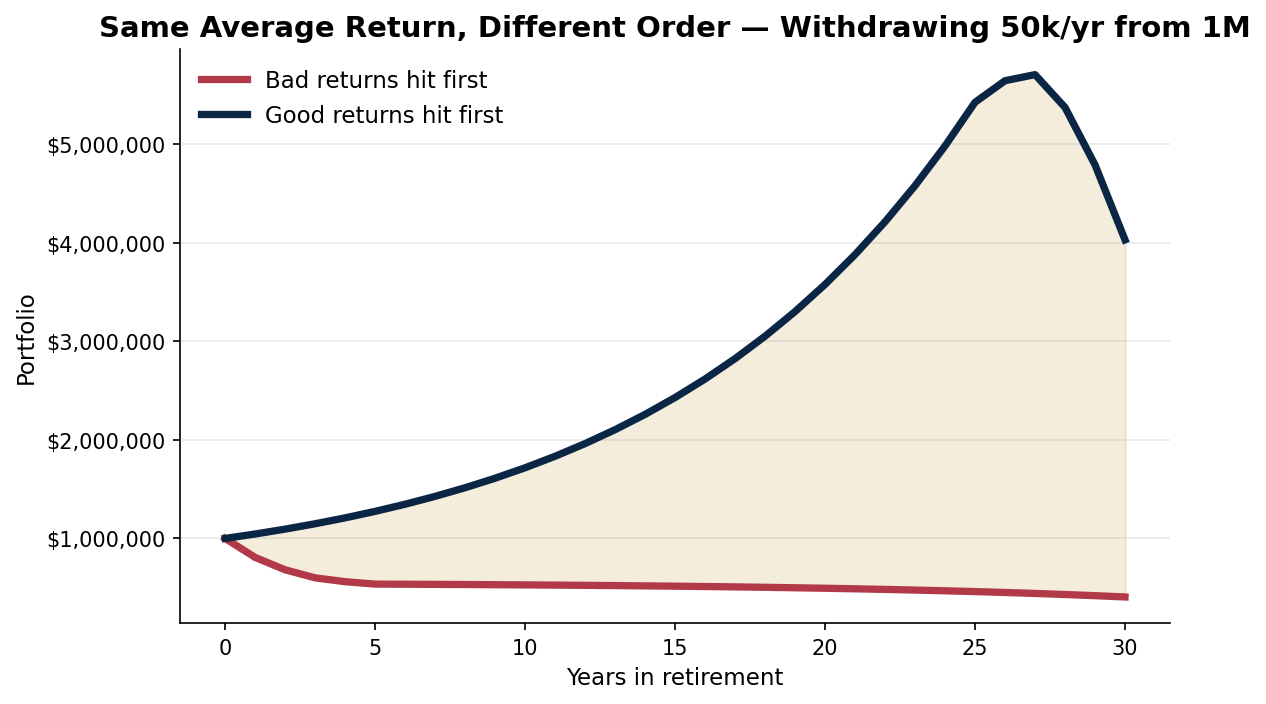
Both lines hit a 7% average. The red retiree drew down during a bad opening stretch and never recovered. The navy retiree caught the good years first, built a cushion, then could absorb the bad ones.
This is sequence of returns risk. And almost no one talks about it until they’re standing on the cliff.
Why the order matters so much
When you’re saving (accumulation), volatility is actually your friend — bad markets let you buy more shares cheap. When you’re withdrawing (decumulation), volatility is the enemy. Selling shares in a down market locks in losses you can never make back.
A 30% drop in year one of retirement is mathematically devastating. A 30% drop in year 25 barely matters. The math is brutal and it doesn’t care what you “deserve” after working for 40 years.
What you can actually do about it
You can’t control when bear markets happen. You can control everything around them:
Cash buffer: keep 1–2 years of expenses in cash or T-bills, so you don’t have to sell stocks during a crash
Bond tent: increase bond allocation in the 5 years before and after retirement, then glide back down
Dynamic withdrawals: use Guyton-Klinger or similar rules — cut withdrawals in down years, raise them in good years
Delayed Social Security: every year you delay past 62 raises your benefit ~8%, which is sequence-risk insurance
Action this week: If you’re within 10 years of retirement, look at your asset allocation. If you’re 90% stocks and you’re 58, that’s not aggressive — that’s exposed. Build the bond tent now, while markets are fine.
The takeaway
The 4% rule, the safe-withdrawal-rate research, all the retirement math you’ve read — none of it has anything to say about your specific bad luck. You don’t get to pick your retirement year. You just get the one you get.
Plan as if you retired in 1929. If that plan still works, the rest is upside.
Sources
• Bill Bengen 2025 update on the 4% rule (now 4.7%)
• Vanguard — Lump sum vs. dollar-cost averaging
— — —
Disclaimer
Affluent Notes is for educational and entertainment purposes only. Nothing in this newsletter is financial, tax, legal, or investment advice. The numbers, charts, and strategies discussed are illustrative; your situation, tax bracket, plan rules, and risk tolerance are different. Past performance does not guarantee future results. Talk to a licensed CPA, CFP, or attorney before acting on anything you read here. The author may hold positions in securities or accounts mentioned.