How to Tap Your 401(k) Decades Before 59½ — Without the 10% Penalty
t's called the Roth conversion ladder. Early retirees use it constantly. Most savers have never heard of it.

Quick question: how do you spend your 401(k) at 50, when the IRS says you can’t touch it without a 10% penalty until 59½?
The standard answer is: “You don’t. You wait.” The actual answer — the one used by people in the FIRE movement, by mid-career career-pivoters, by anyone who wants out before traditional retirement age — is the Roth conversion ladder. It’s been legal since 2010. Vanguard, Fidelity, and Schwab all support it. And it’s barely mentioned outside personal-finance subreddits.
How does it actually work?
There are two rules in the tax code that make this whole thing run:
You can convert money from a Traditional IRA or 401(k) into a Roth IRA at any age. You owe ordinary income tax on the conversion, but no 10% early-withdrawal penalty.
Once converted, the principal sits in a 5-year holding pen. After that 5 years, you can withdraw the principal of that conversion tax-free and penalty-free, regardless of your age.
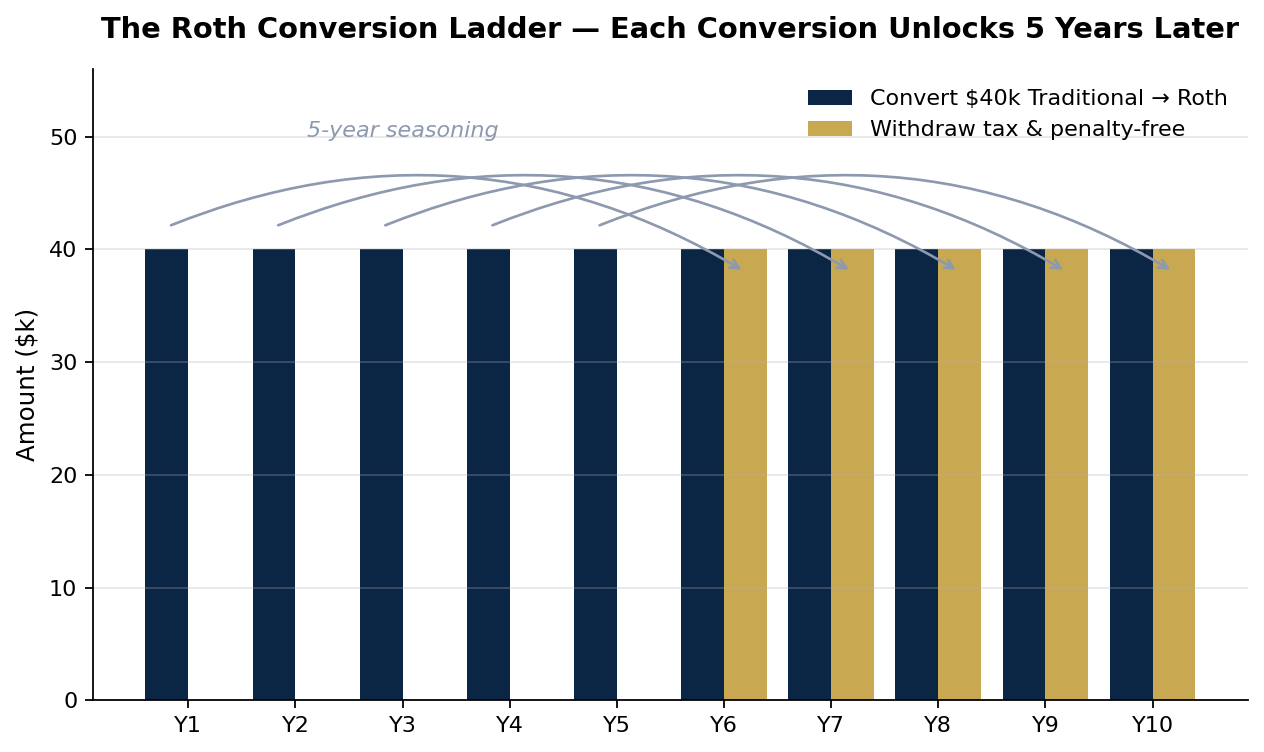
Stack those two together and you get a ladder: convert each year, wait 5 years, then start pulling out the seasoned conversions one rung at a time.
A concrete example
Say you retire at 50 with $1.5M in a Traditional IRA. You need about $40,000/yr to live on. Here’s what the ladder looks like:
Year 1 (age 50): Convert $40k from Traditional → Roth. Pay tax on it at your low retired income. Live off cash savings or a brokerage.
Year 2 (51): Convert another $40k. Live off taxable savings.
Years 3, 4, 5: Keep converting. Keep living off savings.
Year 6 (55): The Year 1 conversion has now “seasoned” 5 years. Pull out that $40k tax-free, penalty-free. Live on it.
Year 7 (56): Pull out the Year 2 conversion. Repeat forever.
By the time you’re 60, the Roth IRA itself is fully unlocked, and the ladder has done its job: you bridged the gap from early retirement to 59½ without ever paying the 10% penalty.
Why does this beat just withdrawing early and paying the penalty?
Because of tax bracket arbitrage. Most retirees go from a 24% or 32% working bracket to the 12% or 22% retired bracket. Converting in those years, while your income is low, is one of the cheapest tax events available in the U.S. tax code.
Here’s the kicker: every dollar you convert in your low-income years is a dollar you don’t have to take as a Required Minimum Distribution at age 73, when your tax bracket may be much higher.
Action this week: If you have a Traditional IRA or old 401(k), open a Roth IRA at the same brokerage if you don’t already have one. The mechanics of the conversion are 3 clicks once both accounts exist. Don’t actually convert anything yet — first run a tax projection so you know what bracket you’ll land in. A CPA or a tool like Boldin (formerly NewRetirement) can model this in 30 minutes.
Where the ladder breaks
You don’t have 5 years of taxable savings to bridge the seasoning period. (Build the bridge fund first.)
Your state has weird Roth conversion rules — Pennsylvania, in particular, taxes conversions differently. Check yours.
Conversions stack on top of any other income for the year. If you have a side gig or rental income, that pushes you into a higher conversion bracket.
The one-line version
The 10% early-withdrawal penalty isn’t a wall. It’s a paywall, and the Roth conversion ladder is the side door the IRS literally wrote into the tax code.
Sources
NerdWallet — Roth Conversion Ladder explained — https://www.nerdwallet.com/retirement/learn/roth-conversion-ladder
ChooseFI — Roth Conversion Ladder for early retirement — https://choosefi.com/tax-strategies/roth-conversion-ladder
Fidelity — The Roth IRA 5-year rule — https://www.fidelity.com/learning-center/personal-finance/retirement/roth-ira-5-year-rule
Schwab — Five-year rule for Roth conversions — https://www.schwab.com/learn/story/what-to-know-about-five-year-rule-roths
SmartAsset — How a Roth conversion ladder works — https://smartasset.com/retirement/roth-ira-conversion-ladder
Disclaimer
Affluent Notes is for educational and entertainment purposes only. Nothing in this newsletter is financial, tax, legal, or investment advice. The numbers, charts, and strategies discussed are illustrative; your situation, tax bracket, plan rules, and risk tolerance are different. Past performance does not guarantee future results. Talk to a licensed CPA, CFP, or attorney before acting on anything you read here. The author may hold positions in securities or accounts mentioned.